
Anova Culinary
Anova Precision Cooker 3.0
The default full size circulator: enough wattage to bring a 12 quart bath up quickly and hold it, with app control for long overnight cooks.
Sixteen calculators covering sous vide time by thickness, pasteurization against the USDA published minimums, air fryer conversion, pressure cooking with altitude, brine and fermentation percentages, ice cream base ratios, vacuum bag sizing and espresso brew ratios. Every one shows its formula, and the pasteurization calculator returns nothing rather than guessing below the published safe minimum.
Each calculator states where its numbers come from. Published USDA and FSIS figures are quoted and linked. Derived figures name the model and its assumptions. Anything we cannot defend returns nothing and says why, which on a food safety topic is a feature rather than a gap.
Sous vide and food safety
Work out how long the core of a cut takes to reach bath temperature, from its thickness and shape. Thickness sets the time, not weight.
Pick a protein and a doneness and see the bath temperature, alongside the USDA published safe minimum internal temperature for that category.
Check a sous vide temperature against the USDA published safe minimum internal temperature for that category, and see plainly when we will not give you a hold time.
Look up the core temperature for any doneness, in any cooking method, against the USDA published safe minimum internal temperature.
Heat and pressure
Convert any conventional oven time and temperature to air fryer settings, with a check-early time so you do not find out by burning it.
Adjust a pressure cooking time for altitude and for the difference between a stovetop cooker at 15 psi and an electric one at about 11 psi.
Convert an induction power level into average watts, and understand why a power level is not a temperature.
Adjust a dehydrator run time for slice thickness and kitchen humidity, because the number in the manual assumes neither.
Ratios by weight
Work out salt and sugar by weight for a standard brine or an equilibrium brine, because a tablespoon of salt is not a fixed amount of salt.
Calculate lacto-fermentation salt as a percentage of the combined vegetable and water weight, with the bands that decide how fast and how safely it ferments.
Balance fat, sugar and milk solids in an ice cream base, and see whether a Ninja Creami pint will spin smooth or need a re-spin.
Calculate espresso yield from dose and ratio, see which style you are pulling, and get the flow rate from your shot time.
Sealing, scaling and cost
Work out the minimum vacuum bag size for a piece of food, and whether an external sealer can handle the job at all.
Work out at what vacuum level your liquid will start boiling in a chamber sealer, using the Antoine equation, and how cold it needs to be first.
Scale ingredient quantities between serving counts, and understand which parts of a recipe do not scale at all.
Work out what a batch actually costs per serving, and how many batches it takes for an appliance to pay for itself.
Gear that fits these numbers
The default full size circulator: enough wattage to bring a 12 quart bath up quickly and hold it, with app control for long overnight cooks.

One second and half a degree. On a page about pasteurization that accuracy is not a luxury, it is the difference between a figure meaning something and not.
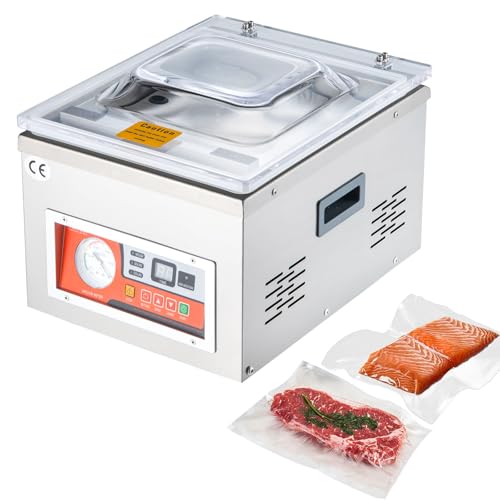
The cheapest genuine chamber machine worth owning, and the entry point at which sealing liquids stops being a fight.
Prices when last checked. They change often.
If you are cooking sous vide, start with the time by thickness calculator, because thickness is the variable that decides everything and weight is the one most charts wrongly use. If you are buying rather than cooking, start with the cost per serving calculator, which answers whether a machine pays for itself before you own it.
Partly, and they are explicit about the limits. They quote the USDA safe minimum internal temperatures and will confirm when your target meets them. Below those figures the pasteurization calculator deliberately returns nothing, because a correct hold time comes from the FSIS Appendix A lethality tables for a specific product and a single number would be wrong for somebody.
The results panel is rendered with its default values already worked out, so the page is readable, crawlable and quotable before any script runs. Changing the inputs needs JavaScript, but the formula, the worked example and every table on the site are plain HTML that survives being read by anything.
Three sources, and every calculator says which applies. Published USDA and FSIS figures are quoted with a link. Derived figures come from a stated physical model with its assumptions written out, such as the conduction model behind come-up time or the Antoine equation behind vacuum boiling points. Anything we cannot defend returns nothing.