
Anova Culinary
Anova Precision Vacuum Sealer Pro
A wet mode that pulls a shorter, gentler vacuum is what lets an external sealer handle a marinated steak without sucking liquid into the pump.
Allow one inch of width beyond the food and three inches of clear film above it for an external sealer, or two inches for a chamber machine. A 6 by 8 inch steak therefore needs at least a 7 by 11 inch bag in an external sealer.
The formula
minimum width = food width + 1 in minimum length = food length + headroom headroom: external sealer 3 in chamber machine 2 in External sealers need embossed film. Chamber machines use smooth film. They are not interchangeable.
An external sealer pulls air out through the open end of the bag, which only works because the film is embossed with channels. A smooth chamber bag in an external machine collapses on itself and never evacuates, which looks exactly like a broken machine.
Gear that fits these numbers
An external sealer is cheap, compact and cannot do liquids. A chamber machine costs several times more and makes soup, brine and marinated meat a non-event.
A wet mode that pulls a shorter, gentler vacuum is what lets an external sealer handle a marinated steak without sucking liquid into the pump.
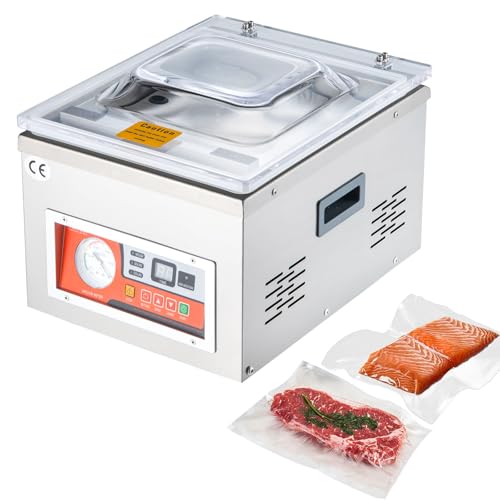
The cheapest genuine chamber machine worth owning, and the entry point at which sealing liquids stops being a fight.
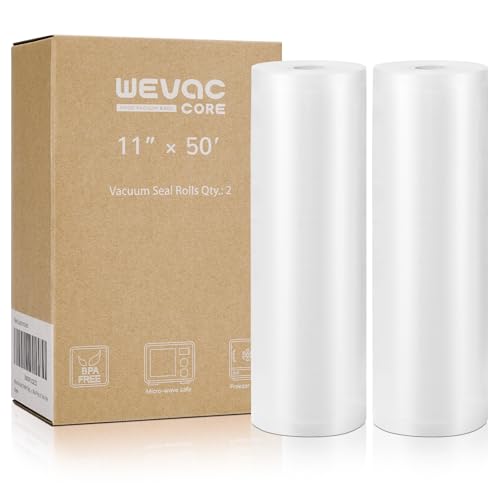
Embossed channels are what let an external sealer pull air out at all. A smooth chamber bag in a suction machine simply never evacuates.

Chamber bags are smooth and cheaper per bag than embossed film, and they only work in a chamber machine. Mixing the two up is the most common first week mistake.

The bag detection is the feature that earns its keep in daily use: you stop guessing at moist versus dry settings and stop wasting bags on a failed seal.

Pre-cut quart bags are the right default for single portions: cutting from a roll costs you a seal at each end and about four inches of film.
Prices when last checked. They change often.
An external sealer clamps the open end of the bag over a seal bar and pulls air through it. It needs enough clear film to make that clamp, and enough distance that nothing wet or greasy reaches the weld. Three inches is the working figure. Less than that and seals start failing, usually a week later in the freezer rather than immediately, which is the worst way to find out.
Embossed film has channels moulded into it so air has somewhere to travel as the bag collapses. Chamber bags are smooth, because a chamber machine removes the air from around the bag rather than through it, and smooth film is both cheaper per bag and completely useless in an external sealer. Buying the wrong box is the most common first week mistake and it presents as a machine that will not pull a vacuum. See {{/compare/chamber-vs-external-vacuum-sealer/|the full comparison}} before you buy either.
A typical 6 by 8 inch steak needs at least a 7 by 11 inch bag in an external sealer: one inch of extra width, and three inches of clear film above the food for the seal. In a chamber machine two inches of headroom is enough, because the bag is not being pulled through a channel.
No. Chamber pouches are smooth, and an external sealer needs embossed film with moulded channels so that air has a path out as the bag collapses. A smooth bag in an external machine simply presses flat against itself and never evacuates, which looks like a fault in the machine rather than the wrong consumable.
Freeze it first. Pour the soup into a container or a bag laid flat, freeze it solid, then seal the frozen block. Sealing liquid directly pulls it toward the pump, which both ruins the seal and shortens the life of the machine. If you do this often, a chamber sealer pays for itself in avoided frustration.
Usually contamination in the weld. Grease, moisture or a crumb of food in the seal line makes a join that looks fine and leaks slowly, so the bag is loose a week later. Keep three inches of clear film, wipe the seal area, and fold a paper towel inside the bag below the seal line when sealing anything damp.
No, it wastes film. Bags are cut to length from a roll, so a roll much wider than your food means you are paying for material that gets sealed shut and thrown away. Most home kitchens are served by an 8 inch and an 11 inch roll, with anything wider handled by cutting the food down instead.
How this calculator works: it applies the formula above to the numbers you enter. Where a figure is published by the USDA or FSIS we quote it and name the source. Where a figure is derived from a physical model we say so and state the assumptions. Where we have no defensible figure the calculator returns nothing and tells you why, rather than guessing. This is researched general information, not professional food safety advice.