
Ninja
Ninja Foodi DZ550 DualZone Smart XL Air Fryer, 10 Quart
The DualZone with a cook probe, which is the feature that turns an air fryer from a timer box into something you can actually cook a thick chicken breast in.
To convert an oven recipe to an air fryer, drop the temperature by 25 F and cut the time by about 20 percent. A dish that calls for 400 F for 30 minutes becomes 375 F for 24 minutes, and you should start checking at around 18 minutes because baskets vary more than manuals admit.
The formula
air fryer temperature = oven temperature - 25 F (rounded to 5 F) air fryer time = oven time x 0.80 first check = oven time x 0.60
This is the rule of thumb printed in essentially every manufacturer manual, and it is a starting point rather than a law. An air fryer is a small chamber with an aggressive fan, so it moves far more air over the food per unit of volume than a full sized oven does. Crowded baskets, low voltage and a cold start all push the real number around.
Gear that fits these numbers
A two basket machine lets a protein and a vegetable run at different settings and finish together, which is the conversion problem solved in hardware rather than arithmetic.
The DualZone with a cook probe, which is the feature that turns an air fryer from a timer box into something you can actually cook a thick chicken breast in.

The Crispi with two more functions and a larger container, and the version worth the jump if you cook for more than two.

A ceramic, PFAS free basket, which is the reason to pick it over the Ninja equivalents if coating chemistry matters to you.
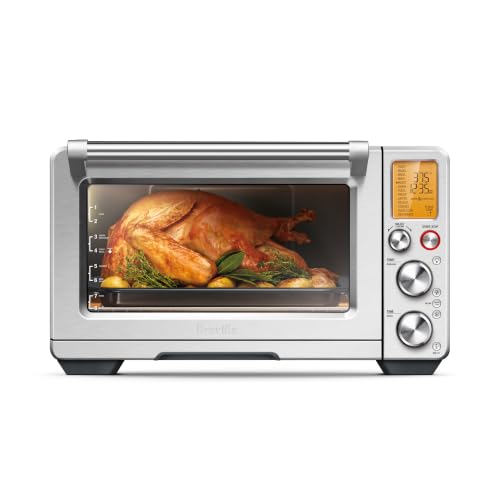
The countertop oven that behaves like a real oven: element control front to back rather than one heat setting, and enough interior to roast for four.

One second and half a degree. On a page about pasteurization that accuracy is not a luxury, it is the difference between a figure meaning something and not.

The Instant Brands answer to the Ninja Max XL, and usually the cheaper of the two at the same capacity.
Prices when last checked. They change often.
An air fryer is a convection oven with a small chamber and a large fan. Convection moves heat into food faster than still air, and a small chamber means the air is recirculated over the food many more times per minute than in a full sized oven. The net effect is that the same surface temperature is delivered by a lower set point in less time, which is what the rule of thumb approximates.
It is only an approximation. The gap between models is large, basket materials differ, and mains voltage varies enough to matter on a 1,700 watt appliance. Treat the output as a starting point and write down what actually worked for your machine.
Anything that relies on still air will behave differently. Delicate batters get blown around, loose seasoning ends up in the element, and tall rising bakes set on the outside before the middle has lifted. Cookies are the classic case and need a much lower temperature than the rule suggests. See {{/air-fryer-time/|the air fryer time charts}} for foods where the conversion is not the right starting point at all.
Reduce the temperature by 25 F and multiply the time by 0.8. A recipe calling for 400 F for 30 minutes becomes roughly 375 F for 24 minutes. Begin checking at about 60 percent of the original time, because the variation between air fryer models is wider than the variation between ovens and the food browns faster than most people expect.
Usually the basket is too full. Airflow is the mechanism, so food that overlaps or blocks the path steams rather than crisps, and the effective cooking rate collapses. A low mains voltage and skipping the preheat both contribute as well. Cook in a single layer with visible space between pieces and the numbers line up much better.
Poorly, for anything that rises. The fan sets the outside of a cake or a tall bake before the centre has lifted, and the result is a domed crust over a raw middle. Cookies work at a much lower temperature than the rule suggests, around 320 F, and anything with a loose batter is better left in a conventional oven.
Yes for anything you want crisp, and it makes a visible difference on frozen foods and breaded items. A cold start means the surface spends its first minutes drying rather than browning. Machines with a preheat cycle usually take two to four minutes, which is short enough that skipping it is a false economy.
Use a smaller adjustment. A full sized countertop oven with convection has a bigger chamber and a gentler fan, so around 15 F and 10 percent is closer than the air fryer figures. The larger the chamber, the smaller the correction, which is really just the same principle running in reverse.
How this calculator works: it applies the formula above to the numbers you enter. Where a figure is published by the USDA or FSIS we quote it and name the source. Where a figure is derived from a physical model we say so and state the assumptions. Where we have no defensible figure the calculator returns nothing and tells you why, rather than guessing. This is researched general information, not professional food safety advice.