Duxtop 9600LS review: twenty steps of induction power for holding a temperature
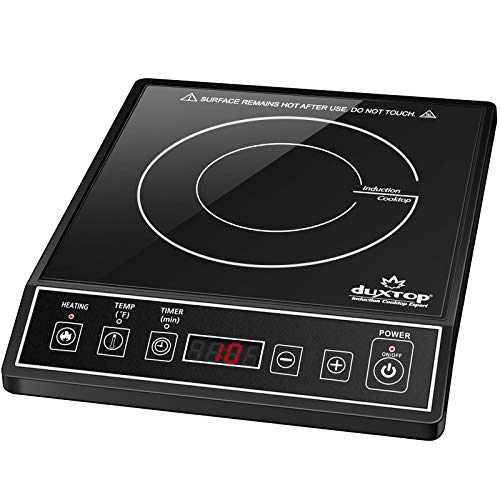
The Duxtop Portable Induction Cooktop 9600LS costs $116.99, runs at up to 1800 watts, and offers 20 power steps and 20 temperature steps, roughly double the 10 steps most budget induction hobs give you.
The Duxtop 9600LS costs $116.99 and its real advantage over a cheaper induction hob is granularity: 20 power steps and 20 temperature steps instead of the usual 10, which matters the moment you are holding something at a specific temperature rather than just boiling water fast. It is not a full replacement for a dedicated temperature controller, but for the price of a mid range air fryer it gets you meaningfully closer to one than a basic single dial hotplate does.
What does an induction power level actually control?
A power level on the Duxtop 9600LS, like on any consumer induction hob, is a percentage of maximum wattage, not a temperature. Setting it to 50 percent does not mean the pan will settle at some fixed number of degrees; it means the element is delivering roughly half of its 1800 watt maximum. Most consumer hobs achieve the intermediate levels between fully on and fully off by duty cycling: running at full power for a fraction of a second, then cutting off, repeatedly, so the average power over time matches the selected percentage. That is why a low power setting can still scorch a delicate sauce: during each on pulse, the pan bottom briefly sees full power, and a thin layer of sauce touching the pan surface at that instant can burn even though the average power looks gentle.
| Specification | Value |
|---|---|
| Power | 1800 W |
| Power steps | 20 |
| Temperature steps | 20 |
| Display | LCD |
| Price | $116.99 |
Why do two different pans on the same power setting behave differently?
Induction heats the pan itself through an induced electrical current, not the cooktop surface, so how hot a pan gets at a given power setting depends on that pan's material, thickness and how well it couples with the induction coil. A thin steel pan and a thick clad stainless pan set to the same 50 percent power level on the Duxtop 9600LS will reach different temperatures, because the thinner pan has less mass to spread the same duty cycled pulses across. This is not a flaw specific to the Duxtop; it is true of every induction hob, and it is the reason a recipe that says medium heat on an induction hob is giving you a starting point, not a guarantee, and the induction power setting to temperature calculator is built around that same caveat rather than pretending one setting maps to one number for every pan.
Does having 20 steps instead of 10 actually change how you cook on it?
Yes, in the specific case of holding a delicate temperature rather than boiling or searing. A budget hob like the Duxtop 9100MC at $84.99 offers only 10 power and 10 temperature steps, which means each step represents a bigger jump in average power delivered. For rapid boiling or a hard sear, that coarseness barely matters, since you are running near maximum anyway. For something like tempering chocolate, holding a custard just under a simmer, or melting butter without breaking it, the gap between step 3 and step 4 on a 10 step hob can be the difference between holding steady and slowly creeping past the target, where the same gap split across 20 steps on the 9600LS gives you a finer in between option to land on.
How does the temperature mode differ from the power mode, and which should you use?
The 9600LS offers both a power mode, set as a percentage of maximum wattage, and a temperature mode, where the unit uses its own sensor to estimate pan surface temperature and cycles power to try to hold that number. The manual states the temperature mode is an estimate based on the cooktop's own sensor, not a probe inside the food, so it reads the pan, not the sauce or the oil in it. For genuinely precise control of the food itself rather than the pan, pairing the cooktop with an instant read thermometer like the Thermapen ONE to spot check the actual contents remains the more reliable approach, with the cooktop's temperature mode used as a rough autopilot between checks.
Who should buy the alternatives instead?
If you only need a portable burner for boiling pasta water or searing a steak and never hold a delicate temperature, buy the Duxtop 9100MC instead and save over thirty dollars, since its coarser 10 step control costs you nothing in that use case. If you regularly cook two things that need different heat levels at once, the Duxtop double induction cooktop gives you two zones on one body, though its total 1800 watts is shared between them, so running both zones hard at once is slower than running either alone. If single degree resolution across a wide range matters more than price, the Nuwave Pro Chef offers control down to a single degree across 100 F to 575 F, at a similar price to the Duxtop. The 9600LS sits as the value pick among the finer grained options rather than the absolute cheapest induction hob on the market.
Gear that fits these numbers
Everything mentioned on this page
Duxtop Portable Induction Cooktop 9100MC
The cheap workhorse. Good for boiling and searing, coarse for anything that needs a held temperature.

Duxtop Double Induction Cooktop 9620LS
Two zones on one plug, which means the total wattage is shared. Running both hard at once is slower than running either alone.

Nuwave Pro Chef Induction Cooktop
Single degree control across a wide range, which is the closest a portable hob gets to the behaviour of a dedicated temperature controller.

ThermoWorks Thermapen ONE
One second and half a degree. On a page about pasteurization that accuracy is not a luxury, it is the difference between a figure meaning something and not.
Prices when last checked. They change often.
Frequently asked questions
Does the Duxtop 9600LS work with any pan, or only induction specific cookware?
It only works with cookware that is magnetic, since induction heats the pan through an induced current that requires a ferromagnetic base. Cast iron and most stainless steel with a magnetic base work; pure aluminum, copper, and glass do not unless they have an induction compatible base built in. A simple test is holding a refrigerator magnet to the pan's underside: if it sticks, the pan will work on induction.
Why does my sauce still scorch on a low power setting on the Duxtop 9600LS?
Because a low power setting is not a low temperature, it is a low percentage of maximum wattage delivered through rapid on and off pulses called duty cycling. During each on pulse, the pan bottom briefly reaches full power, and food sitting directly against the pan surface at that instant can scorch even though the average power over time is low. Stirring more frequently or using a heavier pan that spreads those pulses more evenly reduces this effect.
What is the actual difference between the Duxtop 9600LS and the Duxtop 9100MC?
Both run at up to 1800 watts, but the 9600LS offers 20 power and 20 temperature steps against the 9100MC's 10 of each, giving the 9600LS finer control for holding a delicate temperature. The 9100MC is the cheaper option at $84.99 and is a fine choice if you mostly boil and sear rather than hold a precise heat.
Can the Duxtop 9600LS replace a stovetop burner entirely?
For a single burner's worth of cooking, largely yes, provided your cookware is induction compatible, though it draws on a standard household outlet rather than a dedicated range circuit, so running it alongside other high draw appliances on the same circuit can trip a breaker. It does not replace an oven or a second and third burner, which is why most owners use it as a portable addition rather than a full range replacement.
Does the temperature mode on the Duxtop 9600LS measure the food or the pan?
It measures the pan itself through the cooktop's own sensor, not the food or liquid inside it. That means a thin sauce near the pan surface can run hotter than the displayed temperature suggests, since heat has to travel from the pan into the food, and the two can lag behind each other, especially early in a cook before everything reaches equilibrium.
Is 1800 watts enough power to bring a large stockpot to a boil quickly?
1800 watts is roughly comparable to a strong gas burner and will bring several quarts of water to a boil in a reasonable time, though a very large stockpot filled to capacity will take noticeably longer than a smaller pot at the same setting, simply because there is more mass to heat. For genuinely large batch cooking, a stovetop range burner rated above 1800 watts will still outperform any single portable induction unit.
Sources
Published figures, quoted as published. We do not generate our own time and temperature data.
How we research: we compare manufacturer specifications, owner manuals, published USDA and FSIS figures and recurring themes in verified owner reviews. We do not cook test batches or run instruments, and nothing here is professional food safety advice. When a figure is not published by a source we trust, we say so rather than estimate one.