The best portable induction cooktop for precision searing
The Nuwave Pro Chef at $179.99 is the best portable induction cooktop for precision cooking, with single degree control from 100 F to 575 F. The Duxtop 9100MC at $84.99 is the best budget pick for searing and boiling.
The Nuwave Pro Chef at $179.99 is the pick for anyone finishing a sous vide bag in a hot pan or holding a fry oil temperature steady, because single degree adjustment across a 100 F to 575 F range is the closest a portable hob gets to a dedicated temperature controller. The Duxtop 9100MC at $84.99 remains the right first purchase if all you need is a reliable boil and sear.
The three tiers
Every roundup here is built as three genuinely different answers rather than one flat ranking, because that is how people actually shop: a first purchase, a considered upgrade, and a ceiling. The expert pick is not the best pick for most readers, and the section below says who should skip it.
Duxtop Portable Induction Cooktop 9100MC
1,800 watts with 10 power and 10 temperature steps and a 170 minute timer, at $84.99. It boils water fast and sears a steak well; coarse steps are the honest tradeoff for the price.
Skip it if: Skip it if you plan to hold a low, exact temperature for candy making, tempering chocolate or a slow simmer sauce. The 10-step resolution leaves noticeable gaps between settings at the low end.
Duxtop Portable Induction Cooktop 9600LS
The same 1,800 watts split into 20 power and 20 temperature steps instead of 10, at $116.99, which halves the gap between settings and makes holding a specific simmer far more realistic.
Skip it if: Skip it if you already need single-degree accuracy for candy stages or tempering: 20 steps is a real improvement over 10, but it is still a stepped range, not a continuous one.
Nuwave Pro Chef Induction Cooktop
Single degree adjustment from 100 F to 575 F, at $179.99. This is the model to buy for finishing sous vide proteins at a specific pan temperature or holding fry oil within a couple of degrees.
Skip it if: Skip it if you only boil, steam or do general stovetop cooking. The single-degree range is wasted on tasks that never needed finer than 10-step control in the first place.
Gear that fits these numbers
The three picks side by side
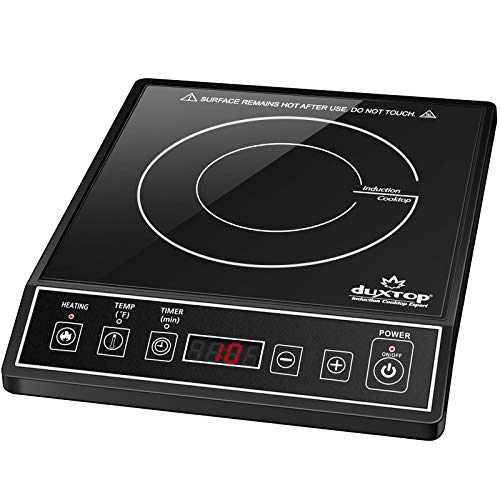
Duxtop Portable Induction Cooktop 9100MC
The cheap workhorse. Good for boiling and searing, coarse for anything that needs a held temperature.
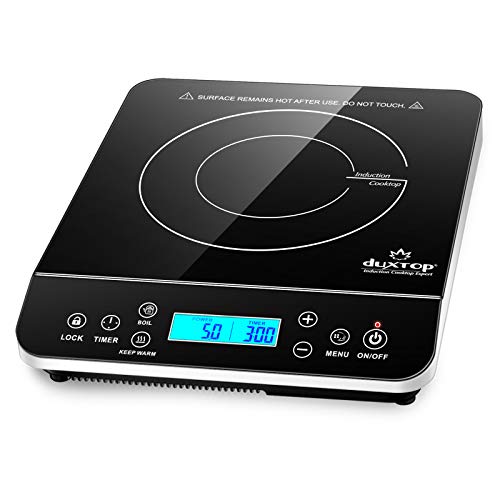
Duxtop Portable Induction Cooktop 9600LS
Twenty steps rather than the usual ten, which is what makes it usable for holding a temperature rather than just boiling.

Nuwave Pro Chef Induction Cooktop
Single degree control across a wide range, which is the closest a portable hob gets to the behaviour of a dedicated temperature controller.
Prices when last checked. They change often.
Why does step count matter more than wattage on an induction burner?
Every portable induction cooktop in this price range runs at roughly the same 1,800 watt maximum, since that is the practical ceiling for a standard household outlet. What actually differs between models is how finely that power is divided into steps. A 10-step burner like the Duxtop 9100MC jumps in large increments, which is fine for boiling water or searing a steak where the exact number barely matters. A 20-step model like the Duxtop 9600LS or a single-degree model like the Nuwave Pro Chef narrows that gap, which becomes the deciding factor the moment you are holding an oil temperature for frying or a simmer just below boiling for a long reduction.
Portable induction cooktop comparison
Prices and step counts across the current lineup, from the cheapest single-zone model to the double burner.
| Model | Power | Steps | Price |
|---|---|---|---|
| Duxtop 9100MC | 1,800 W | 10 power, 10 temp | $84.99 |
| Duxtop 9600LS | 1,800 W | 20 power, 20 temp | $116.99 |
| Duxtop P961LS | 1,800 W | 20 power, 20 temp, stainless body | $167.99 |
| Nuwave Pro Chef | 1,800 W | Single degree, 100 to 575 F | $179.99 |
| Duxtop double | 1,800 W total, 2 zones | 20 power, 20 temp per zone | $217.02 |
Does my existing cookware even work on induction?
Induction only heats cookware with a magnetic base, which rules out pure aluminum, copper and most glass or ceramic pots that have no steel content. The simple test is a refrigerator magnet: if it grips firmly to the bottom of a pan, that pan works on any of these cooktops, including the Duxtop 9100MC and the Nuwave Pro Chef. Most stainless steel and cast iron cookware passes this test, while all-aluminum pans and most all-copper pans do not unless they have a bonded magnetic base built in specifically for induction. Checking cookware before buying a cooktop avoids the common surprise of an otherwise perfect setup that simply will not turn on with the pan already on it.
Is a double zone cooktop worth it over two single burners?
The Duxtop double puts two induction zones on a single plug and a single body, which saves counter space and outlet count over running two separate single-zone burners. The tradeoff is shared power: the two zones split roughly 1,800 watts total between them, so running both at a high setting simultaneously is slower than running either alone at full power. For someone who genuinely cooks two things at once at high heat, such as searing a protein while reducing a sauce, two separate single-zone units like a pair of Duxtop 9100MC burners avoid that shared power ceiling entirely, at the cost of needing two outlets and more counter space.
Will a portable induction cooktop trip a household circuit?
An 1,800 watt cooktop, which describes every model in this lineup from the Duxtop 9100MC to the Nuwave Pro Chef, draws about 15 amps on a standard 120 volt household outlet, which is at or near the limit of a typical 15 amp kitchen circuit once anything else is plugged into the same circuit. Running an induction cooktop on the same circuit as another high draw appliance, such as a second cooktop, a toaster oven or a microwave, is the most common way a breaker trips mid-cook. A double zone unit like the Duxtop double does not change this: it shares that same roughly 1,800 watt total across both zones rather than drawing double the power, which is exactly why running both zones at maximum heat simultaneously slows down rather than doubling the draw.
How does induction compare with gas for the temperatures this site cares about?
Induction heats the pan directly through a magnetic field rather than heating the air around it, which means it responds to a setting change in seconds rather than the tens of seconds a gas flame takes to stabilize. That responsiveness is exactly what a stepped or single-degree cooktop is built to exploit: a setting change registers in the pan almost immediately, so a 20-step or single-degree model can actually hold the finer temperature it promises. On a gas burner, the flame answers quickly but the pan's own thermal lag smooths out small adjustments anyway, which is part of why fine step counts matter more on an electric or induction surface than on gas.
How we chose
These picks come from published wattage, step count and temperature range specifications from the manufacturers, plus recurring themes in verified owner reviews about how evenly a given step count actually holds a target temperature in practice, and about pan detection reliability, since every induction cooktop refuses to run without a magnetic pan sitting flat on the coil. We did not cook on these units ourselves. Prices are pulled from current listings and are checked at every update.
Gear that fits these numbers
Everything mentioned on this page
Duxtop Portable Induction Cooktop 9100MC
The cheap workhorse. Good for boiling and searing, coarse for anything that needs a held temperature.
Duxtop Portable Induction Cooktop 9600LS
Twenty steps rather than the usual ten, which is what makes it usable for holding a temperature rather than just boiling.
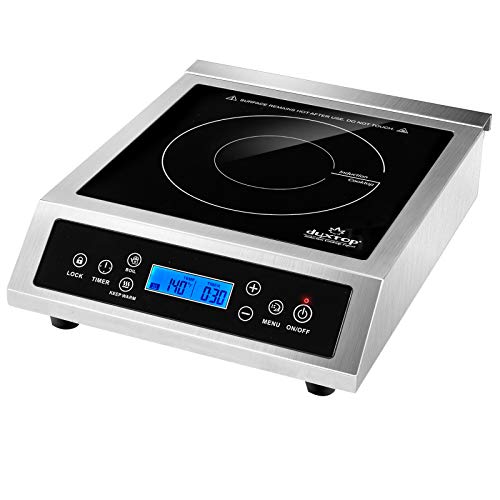
Duxtop Professional Portable Induction Cooktop P961LS
The stainless bodied professional version, built to be wiped down daily rather than stored in a cupboard.

Duxtop Double Induction Cooktop 9620LS
Two zones on one plug, which means the total wattage is shared. Running both hard at once is slower than running either alone.

Anova Precision Cooker 3.0
The default full size circulator: enough wattage to bring a 12 quart bath up quickly and hold it, with app control for long overnight cooks.
Prices when last checked. They change often.
Frequently asked questions
Do I need single degree control for sous vide cooking?
Not for the water bath itself, since a circulator like the Anova Precision Cooker 3.0 already holds bath temperature to within a fraction of a degree on its own. A precise induction cooktop like the Nuwave Pro Chef matters for the finishing step afterward, searing the outside of a sous vide protein in a hot pan or holding fry oil steady, where a stepped burner's gaps are more noticeable.
Is 1,800 watts enough to boil water quickly?
Yes. Every model here, from the $84.99 Duxtop 9100MC to the $179.99 Nuwave Pro Chef, runs at roughly 1,800 watts at full power, which brings a few quarts of water to a boil in a similar amount of time across the lineup. The differences between these models show up in how finely they can be turned down, not in how fast they heat up.
Can a portable induction cooktop replace a gas or electric range?
For a single burner's worth of cooking, yes, and many small kitchens run one as their only cooktop. It cannot replace an oven, and a single-zone unit like the Duxtop 9100MC only cooks one pan at a time unless you step up to a double zone model like the Duxtop double. Any cookware used must also be induction-compatible, meaning it is magnetic on the base. A cheap magnetic adapter plate exists for using non-magnetic cookware on induction, but it adds a layer of metal between the coil and the pan that slows heating and defeats much of the point of buying a precise cooktop in the first place.
What is the difference between the Duxtop 9600LS and the Pro Chef?
The Duxtop 9600LS offers 20 power and 20 temperature steps for $116.99. The Nuwave Pro Chef moves to single-degree adjustment across a 100 F to 575 F range for $179.99. Both are meaningfully finer than a 10-step burner; the Pro Chef is the finer of the two and the better choice for anyone chasing an exact temperature rather than a close one.
Does a stainless body like the Duxtop P961LS cook any differently?
No. The stainless steel body on the Duxtop P961LS is a durability and cleaning choice, not a performance one: it shares the same 1,800 watt output and 20-step control as the plastic-bodied Duxtop 9600LS. The stainless version is built to be wiped down daily in heavier use rather than stored between occasional cooks.
Why won't my induction cooktop turn on with a pan already sitting on it?
Every induction cooktop in this lineup, including the Duxtop 9100MC and Nuwave Pro Chef, uses pan detection that refuses to generate a magnetic field unless it senses a compatible pan flat against the coil. A pan that is not magnetic, sits off-center, or is too small for the coil's sensor ring will read as no pan present. Centering a magnetic pan directly over the coil almost always resolves it.
Sources
Published figures, quoted as published. We do not generate our own time and temperature data.
How we research: we compare manufacturer specifications, owner manuals, published USDA and FSIS figures and recurring themes in verified owner reviews. We do not cook test batches or run instruments, and nothing here is professional food safety advice. When a figure is not published by a source we trust, we say so rather than estimate one.