Breville Joule Turbo review: full power in a body with no display
The Breville Joule Turbo Sous Vide is a 1100 watt immersion circulator priced at $237.07, controlled entirely through a phone app with no display or buttons on the device itself, in the smallest body among the full power circulators covered on this site.
The Breville Joule Turbo costs $237.07 and packs the same 1100 watt output as the Anova Precision Cooker 3.0 into a noticeably smaller body, at the cost of every control living inside the app rather than on the device. It fits a kitchen where drawer space is tight and the buyer is already comfortable running a cook entirely from a phone. We have not tested this unit in person; the wattage, control scheme and size claims below come from Breville's published listing and manual, cross-checked against the patterns that repeat across owner reviews.
What does $237.07 buy without a display?
The Joule Turbo's spec sheet is short on purpose: 1100 watts of heating power, app-only control, and a body built to be the smallest full power option in its category. There is no dial, no screen, and no button beyond a physical clip that holds it to the side of a pot. Every temperature, timer and start command runs through Breville's app over a phone connection, which is the entire design tradeoff this unit makes: less hardware on the counter in exchange for a control surface that lives somewhere else entirely.
| Specification | Value |
|---|---|
| Power | 1100 W |
| Control | App only, no display |
| Size | Smallest full power unit in this category |
| Price | $237.07 |
What does it actually cost to have no display at all?
The practical cost shows up in two moments. First, if the phone running the app dies, loses its connection, or simply is not in the room, there is no way to glance at the device and confirm the set temperature or how much time is left, unlike the Anova 3.0, which shows its set point on the unit itself even without a phone nearby. Second, starting a cook requires opening the app every time, which is a minor friction that some owners report becoming second nature and others find genuinely annoying on a daily basis. Neither issue affects the accuracy of the cook itself: the circulator holds its set temperature the same way with or without the phone connected once a cook is running, since the heating and pump logic lives in the device, not the app.
- 1100 W matches the full size Anova 3.0 for come-up time and holding power
- No way to check the set point without the app, which the Anova 3.0 and the Inkbird ISV-100W both allow via an onboard display
- The smaller body is the actual advantage: it clips flush against a pot wall with less bulk than most full power circulators
Is the smaller size worth the tradeoff for most kitchens?
Only if drawer space is a real constraint rather than a mild preference. A circulator that lives permanently clamped inside a stockpot in a cabinet does not benefit much from being smaller, since the pot itself takes up the space regardless. Where the size genuinely matters is a kitchen with narrow drawers or limited under-counter storage, where every centimeter of a stored appliance counts. For that specific situation, the Joule Turbo's footprint is the strongest argument in its favor, stronger than the app-only control, which most buyers experience as a neutral-to-mild downside rather than a selling point.
Does a smaller body change how the circulator mounts in a pot?
The clip on the Joule Turbo is built to the same principle as any clamp-on circulator: it grips the wall of a pot or dedicated container to hold the unit upright while the pump runs. Because the body is smaller, the clip itself is also more compact, which means it fits comfortably on containers with a narrower rim than some full size units need, an advantage for anyone using a smaller stockpot rather than a dedicated sous vide container. The tradeoff is that a smaller, lighter body sits slightly less stable in a very large or very full bath, particularly once several bags are pushing against it, though this is a minor consideration next to the mounting choices that matter more, such as picking a straight-walled container over a sloped stockpot in the first place. As with every clamp-on circulator in this category, a dedicated container built for the clip gives more consistent results than improvising with mismatched cookware.
When should you buy the Anova 3.0 or the Inkbird instead?
Buy the Anova Precision Cooker 3.0 instead if an onboard display and physical controls matter to you, or if the $32.07 price gap in the Joule Turbo's favor is not worth losing that display for. The 3.0 costs $169.00, which is actually less than the Joule Turbo despite matching it on wattage. Buy the Inkbird ISV-100W instead if budget is the deciding factor: at $95.99 it delivers 1000 watts, WiFi control, and an on-device readout for less than half the Joule Turbo's price, at the cost of a bigger clamp body and a less established brand name.
Does app-only control change anything about safety?
No, the same rule applies regardless of which circulator is running the bath: a sous vide temperature is only safe when paired with a hold time long enough to pasteurize the food at that specific temperature, and those figures come from the USDA FSIS Appendix A lethality tables rather than from any app notification. The app on the Joule Turbo can alert a phone when the bath reaches its set point, which is a convenience for timing that hold correctly, not a substitute for knowing the correct hold time in the first place.
Does the magnetic base add anything the clamp does not?
Many owner reviews mention a magnetic strip near the base of the clamp, which lets the unit stick lightly to a metal pot or an induction cooktop's surface as a secondary anchor beyond the clamp's grip. This is a convenience during setup rather than a safety feature: the clamp itself is still what holds the circulator upright and submerged through the cook, and the magnet mainly helps keep the unit from swinging sideways while it is being positioned before the clamp is tightened. On a non-metal container, such as some dedicated plastic sous vide tubs, the magnet has nothing to grip and the clamp alone does all the work, which is worth knowing before assuming the magnet compensates for a loose clamp fit.
Who should actually buy the Breville Joule Turbo?
Someone who already owns a smartphone they are comfortable keeping nearby during a cook, values a smaller stored footprint over a physical display, and is not deciding based on price alone since it costs more than the equally powerful Anova 3.0. Pair it with the EVERIE 12 quart container for a lid that protects the bath from the evaporation a full power element otherwise has to fight, and a reliable instant read thermometer such as the ThermoPop 2 to confirm doneness independent of the app.
Gear that fits these numbers
Everything mentioned on this page

Anova Precision Cooker 3.0
The default full size circulator: enough wattage to bring a 12 quart bath up quickly and hold it, with app control for long overnight cooks.

Inkbird ISV-100W Sous Vide Cooker
Full wattage at roughly half the price of the name brands, with a waterproof body that survives the splash a clamped circulator eventually takes.

EVERIE 12 Quart Sous Vide Container with Hinged Lid
A lid cut for a circulator is the single upgrade that makes long cooks practical: it stops evaporation, which is what drops the water line and trips a low water alarm at hour nine.
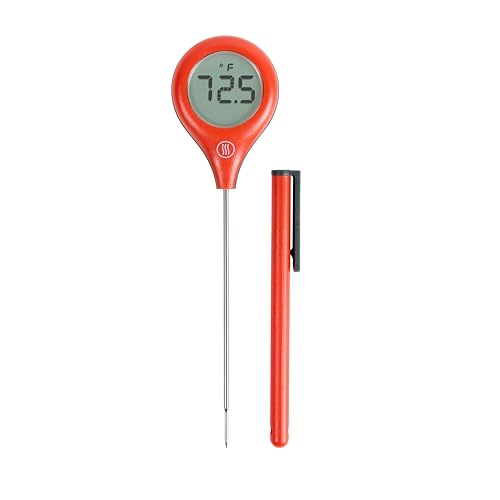
ThermoWorks ThermoPop 2
A third of the Thermapen price for most of the useful accuracy. The right pick if you are buying your first real thermometer.
Prices when last checked. They change often.
Frequently asked questions
Can the Breville Joule Turbo run without a phone at all?
No. Every setting, including the target temperature and the timer, has to be entered through the app before a cook starts, since the device has no display or physical controls beyond the clamp itself. Once a cook is running, the circulator holds its temperature independently of the phone, but starting or changing a cook requires the app to be open and connected.
How much smaller is the Joule Turbo than a full size circulator like the Anova 3.0?
Breville markets it as the smallest full power circulator in its category, though exact dimensions vary by listing. The practical difference shows up most in narrow drawer storage, where a slimmer clamp body takes up noticeably less width than bulkier full power units, even though both run the same 1100 watt element.
Is 1100 watts on the Joule Turbo the same as 1100 watts on the Anova 3.0?
Functionally yes. Both circulators use the wattage figure to describe the maximum heating output of the element, and at the same wattage the come-up time and holding power for a given bath size should be comparable. The meaningful differences between the two units are control scheme and price, not raw heating performance.
What happens if the app disconnects mid-cook on the Joule Turbo?
The circulator continues running the cook it was already set to, since the heating and temperature control logic runs on the device rather than through the phone connection. What is lost during a disconnection is the ability to check progress or change settings until the app reconnects, not the accuracy of the bath itself.
Why does the Joule Turbo cost more than the Anova 3.0 at the same wattage?
The price difference reflects brand positioning and the smaller body rather than any performance advantage, since both circulators run 1100 watts. Buyers who want the smallest possible clamp-on unit and are comfortable with app-only control may find that worth the premium, while buyers focused purely on cost per watt are better served by the cheaper Anova 3.0 or the Inkbird ISV-100W.
Does the Joule Turbo's smaller clip fit a narrower pot rim than other circulators?
Yes, the compact clip is built to match the smaller body and generally fits a narrower rim comfortably compared with bulkier full power circulators. This makes it a reasonable fit for a standard stockpot rather than requiring a dedicated wide-rimmed sous vide container, though a straight-walled container still gives a more secure grip than a sloped or tapered pot regardless of clip size.
Is the Breville Joule Turbo a good first sous vide circulator for a beginner?
It can be, but the app-only control means a beginner has no fallback way to check settings without a working phone and app connection, unlike circulators with an onboard display. A beginner who is comfortable relying entirely on a phone for every part of the cook will find the Joule Turbo works well, while someone who wants a visible readout on the counter is better served by a circulator with a display built in.
What does the magnetic base on the Joule Turbo actually do?
It lets the unit stick lightly to a metal pot or cooktop surface as a secondary anchor while it is being positioned, which is a setup convenience rather than what actually holds the circulator upright during a cook. The clamp mechanism does that job. On a non-metal container the magnet has nothing to grip, and the clamp alone secures the unit exactly as it would on any other clamp-on circulator.
Does the Joule Turbo work with any brand of vacuum sealer bags?
Yes, the circulator itself has no dependency on a specific bag brand, since its job is heating and circulating water rather than interacting with the bag in any way. Any properly sealed bag, whether from an external sealer with embossed film or reusable silicone bags sealed by water displacement, works the same way once it is submerged in the bath, as long as it is rated for the sous vide temperature being used.
Sources
Published figures, quoted as published. We do not generate our own time and temperature data.
How we research: we compare manufacturer specifications, owner manuals, published USDA and FSIS figures and recurring themes in verified owner reviews. We do not cook test batches or run instruments, and nothing here is professional food safety advice. When a figure is not published by a source we trust, we say so rather than estimate one.