Cosori vs Excalibur dehydrator: which one to buy
The Cosori 6 Tray dehydrator costs $143.97 and dries with a rear-mounted fan across 6.5 square feet of stainless trays, while the Excalibur Performance Series 10 Tray costs $379.99 and uses the same non-rotating horizontal airflow principle across a larger square cabinet with adjustable temperature control. Both avoid the tray-rotating chore of older round dehydrators. For most home kitchens making jerky and dried fruit a few times a month, the Cosori is the better value; for high-volume drying or precise low-temperature work, the Excalibur is worth the extra cost.
Buy the Cosori 6 Tray at $143.97 for most home dehydrating: it uses a rear-mounted fan that dries every tray at the same rate, so trays never need rotating, and 6.5 square feet of stainless steel tray space covers a normal batch of jerky or dried fruit without crowding. Step up to the Excalibur Performance Series 10 Tray at $379.99 if you dehydrate often enough to want fully adjustable temperature control down to raw-food range, a larger square cabinet, and stainless trays built for daily use rather than occasional batches. The two brands solve airflow the same way, a fan that moves air horizontally past every tray rather than one that has to be rotated through a hot spot, and the real decision is volume and control, not whether the machine works.
Do these two actually dry food the same way, or is the airflow different?
Mechanically, they are closer than the price gap suggests. The Cosori 6 Tray pulls air in and pushes it out through a rear-mounted fan, moving air horizontally past every tray at once rather than blowing down from the top. The Excalibur 10 Tray uses the same principle in a wider, square cabinet: a horizontal airflow path that reaches every tray at the same rate. Both designs are the reason neither machine asks you to rotate trays partway through a batch, which older round dehydrators with a single bottom or top fan often require, since a tray closer to the fan in that design dries noticeably faster than one further away.
- Rear or horizontal airflow: every tray gets roughly the same air speed and temperature, no rotation needed
- Top or bottom fan in a round unit: trays closer to the fan dry faster, and rotating them partway through is the workaround
- Neither Cosori nor Excalibur needs that workaround, which is the real shared selling point between them
Cosori vs Excalibur, head to head
Price, tray count, and temperature control are where the two lineups actually separate.
| Cosori 6 Tray | Excalibur Performance 10 Tray | |
|---|---|---|
| Price | $143.97 | $379.99 |
| Trays | 6 stainless | 10 stainless |
| Drying area | 6.5 sq ft | Larger square cabinet |
| Airflow | Rear-mounted fan | Horizontal flow |
| Temperature control | Preset digital settings | Fully adjustable dial |
| Viewing | Solid door | Glass door with view window |
Does slice thickness and kitchen humidity actually change drying time this much?
Yes, on both machines, because the airflow design does not change the physics of moving moisture out of food. Time scales roughly with slice thickness: a slice cut twice as thick takes roughly twice as long to dry, not a fixed number of extra minutes. A humid kitchen adds meaningfully to that time as well, typically around 25 percent longer than the same batch dried in dry air, since the machine is working against a smaller difference between the air inside the cabinet and the moisture trying to leave the food. Neither the Cosori nor the Excalibur compensates for humidity automatically; both rely on the cook checking texture rather than trusting a fixed timer setting, especially for a first batch of a new food.
Does drying meat into jerky actually make it safe to eat?
Not by itself. Drying alone does not reliably kill the bacteria that can be present in raw meat, since dehydrator temperatures, even on the higher end of what the Excalibur or the Cosori can reach, sit well below the temperatures needed for a fast kill step. USDA guidance for meat jerky calls for heating the meat to a safe internal temperature, 165 F for poultry or 160 F for ground meat, before or during the drying process, not relying on the drying step to do that work. This is a case where owning a good dehydrator does not replace reading the specific temperature guidance for the type of meat being dried, since the machine's job is moisture removal, not pathogen control.
So which one should you actually buy?
Buy the Cosori 6 Tray if you dehydrate a few times a month for jerky, dried fruit, or vegetable chips and want stainless trays and even airflow without spending close to $400. Buy the Excalibur Performance Series 10 Tray at $379.99 if you dry food often enough that a larger cabinet and fully adjustable low-temperature control, including settings suited to raw food work, are worth the extra cost. If ten trays is more than your kitchen or your batches need but you still want the Excalibur airflow design, the Excalibur Select Series at $179.99 sits between the two, while the Cosori 10 Tray at $299.99 is the larger Cosori option if you would rather stay with the cheaper brand at higher capacity.
Gear that fits these numbers
Everything mentioned on this page

Excalibur Performance Series Food Dehydrator, 10 Tray
The square box with horizontal airflow that every long form drying guide is written around.

Excalibur Select Series Food Dehydrator
The cheaper Excalibur, with the same horizontal airflow that makes the brand worth the premium in the first place.
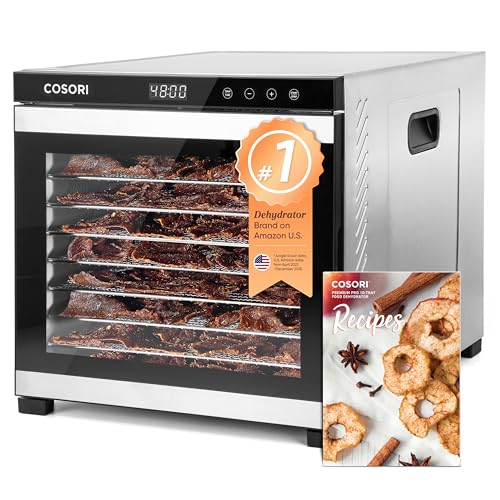
Cosori Food Dehydrator, 10 Stainless Trays
Sixteen square feet of tray, which is a harvest sized machine rather than a jerky sized one.
Prices when last checked. They change often.
Frequently asked questions
Do I need to rotate trays partway through a batch in either machine?
No. Both the Cosori and the Excalibur move air horizontally past every tray at the same rate, using a rear-mounted or horizontal fan rather than a single top or bottom vent. That design is specifically what removes the need to rotate trays, which is a common chore on older round dehydrators where a fan at one end dries the nearest tray faster than the farthest one.
How much longer does a humid kitchen actually make a dehydrating batch take?
Expect roughly 25 percent longer than the same batch dried in a dry kitchen, since humidity in the surrounding air reduces the difference between the air inside the cabinet and the moisture trying to leave the food. This applies to both brands equally, since neither compensates for ambient humidity automatically. Checking texture near the low end of the published time range is more reliable than trusting the clock alone.
Is jerky safe to eat once it looks and feels fully dried?
Not necessarily. Texture tells you the drying is finished, not that the meat reached a safe temperature at some point in the process. USDA guidance calls for heating meat to a safe internal temperature, such as 160 F for ground meat or 165 F for poultry, before or during drying, since dehydrator temperatures alone are usually too low to reliably kill bacteria on their own.
Is the Excalibur's adjustable temperature actually useful, or is it a gimmick?
It is genuinely useful for anyone drying a range of foods, since jerky, herbs, and raw-food style recipes each want a different temperature and the Excalibur's dial covers that range in one machine. The Cosori's presets cover the common cases well, but a dial that can be set anywhere in its range gives more control for less common foods or a specific low-temperature ceiling.
How many trays do I actually need for a normal household?
Five or six trays, like the Cosori 5 Tray or 6 Tray, cover a typical batch of jerky or fruit for a household of two to four without leaving trays half empty. Ten trays make more sense for a household preserving a garden harvest in bulk or running a full batch of jerky for gifting, since fewer, fuller runs beat more frequent small ones.
Do stainless trays matter compared to plastic ones?
Yes, particularly for jerky dried near 160 F, where plastic trays are more likely to warp or absorb odor over repeated use. Both the Cosori and Excalibur lineups here use stainless trays, which clean up more easily and hold their shape better over years of use than the plastic trays found on cheaper dehydrators.
Sources
Published figures, quoted as published. We do not generate our own time and temperature data.
How we research: we compare manufacturer specifications, owner manuals, published USDA and FSIS figures and recurring themes in verified owner reviews. We do not cook test batches or run instruments, and nothing here is professional food safety advice. When a figure is not published by a source we trust, we say so rather than estimate one.